







FCT, Borno, Others to See Above-Normal Rainfall
By Chidi Ugwu
The Nigerian Meteorological Agency (NiMet) has forecasted an early onset of rains across several southern and North-Central states.
Specifically, these regions will experience a longer-than-normal rainy season in parts of the country, including Lagos and Benue, along with generally warmer temperatures nationwide—with major implications for agriculture, aviation, infrastructure, and disaster risk management.
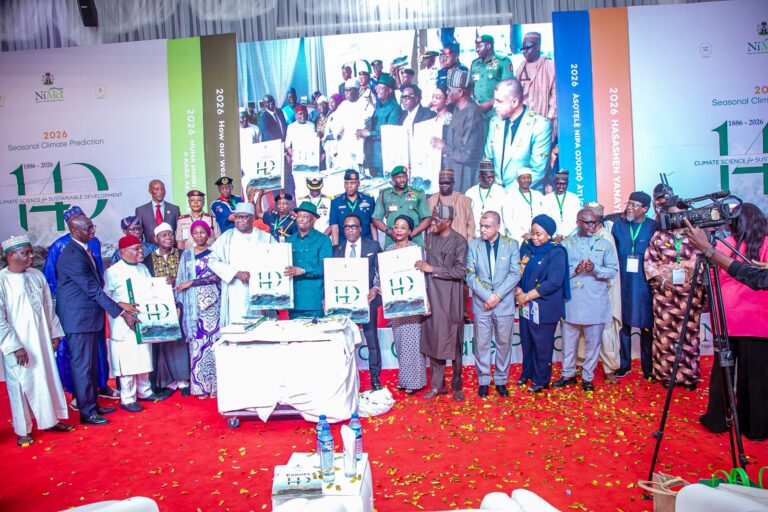
The outlook was unveiled on Monday in Abuja by the Nigerian Meteorological Agency (NiMet) during the public presentation of the 2026 Seasonal Climate Prediction (SCP), where the Minister of Aviation and Aerospace Development, Festus Keyamo, described the document as a strategic national planning tool aligned with the Federal Government’s development priorities.
According to highlights of the 2026 SCP, early rainfall onset is expected in Bayelsa, Rivers, Akwa Ibom, Cross River, Benue, Kogi, Nasarawa, Oyo, and parts of Kebbi, Niger, Jigawa, Katsina, Kano, Adamawa, and Taraba states, while Borno State is likely to experience a delayed onset.
Rainfall cessation is projected to be earlier than normal in parts of Ogun, Osun, Ondo, Imo, Rivers, Akwa Ibom, Kogi, and Niger states, while a delayed end of the rainy season is expected in Lagos, Ogun, Anambra, Enugu, Cross River, Benue, Nasarawa, and Kaduna states.
NiMet also predicted a longer-than-normal rainy season in Lagos, Benue, Enugu, Ebonyi, Ogun, Oyo, Nasarawa, Anambra, Kwara, Kebbi, Kaduna, Gombe, and Taraba states, while parts of Borno, Yobe, and Niger states are expected to record a shorter rainy season.
On rainfall totals, the agency anticipates normal annual rainfall across most parts of the country, with above-normal rainfall expected in Borno, Sokoto, Kebbi, Kaduna, Enugu, Cross River, Abia, Ebonyi, Akwa Ibom states, and the Federal Capital Territory.
Below-normal rainfall is projected for parts of Katsina, Zamfara, Kwara, Oyo, and Ogun states.The SCP also warned of severe dry spells during the season, including dry spells of up to 21 days in parts of Bauchi, Borno, Gombe, Jigawa, Katsina, Kano, Kebbi, Kwara, Nasarawa, Niger, Plateau, Sokoto, Yobe, and Zamfara states.
The August Break is expected to be severe and prolonged in Lagos, Ogun, Ekiti, and parts of Oyo states, lasting between 28 and 40 days.
Both daytime and nighttime temperatures are predicted to be warmer than the long-term average across most parts of Nigeria between January and May 2026.
In his remarks, the Director-General and Chief Executive Officer of NiMet, Prof. Charles Anosike, said the agency remains committed to providing authoritative, science-based climate information to support informed planning and decision-making in Nigeria’s increasingly variable climate.
“As climate variability and extreme weather events increasingly threaten lives, livelihoods, infrastructure, food security, and economic growth, timely and reliable weather and climate information have become indispensable,” Anosike said.
He disclosed that NiMet has begun integrating emerging technologies into its operations, including Artificial Intelligence, to strengthen forecasting accuracy and service delivery.
“We have recently set up a team of experts charged with ensuring that the Agency is at the forefront of integrating and operationalising Artificial Intelligence in our forecasting responsibilities,” he said.
Anosike also highlighted NiMet’s over one hundred years of meteorological service in Nigeria, acknowledging the role of the agency’s pioneer Director-General, Chief Lihwu Eugene Akeh, in laying the foundation for its current operations.
He commended the Federal Government, through the Ministry of Aviation and Aerospace Development, for its sustained support of NiMet, describing the backing as critical to advancing climate-smart and data-driven development in the country.
The NiMet boss called for increased collaboration with state governments to enable wider downscaling of the SCP for local farmers and communities.