







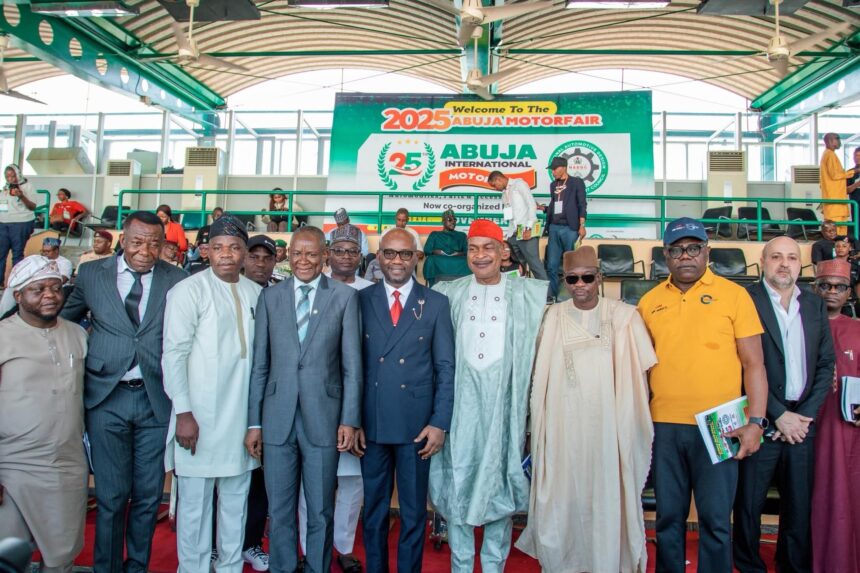
In a decisive step toward reshaping Nigeria’s automotive future, BKG Exhibitions Limited has entered into a strategic partnership with the Motorcycle Manufacturers Association of Nigeria (MOMAN) and the Automotive Local Content Manufacturers Association of Nigeria (ALCMAN), signalling a coordinated private-sector push to accelerate local manufacturing, deepen domestic supply chains, and reduce Nigeria’s long-standing dependence on imported vehicles and components.

Formalised in Lagos, the alliance is already being described by industry observers as one of the most structured attempts in recent years to transition the country’s automotive ecosystem from an import-driven market to a production-led industrial base capable of generating real value addition, technology transfer, and sustainable employment.
For decades, Nigeria’s automotive narrative has revolved largely around the importation of fully built units and, more recently, the assembly of semi-knocked-down and completely knocked-down kits. While these models created pockets of commercial activity, stakeholders argue they delivered limited industrial depth and constrained the growth of indigenous engineering capabilities.
The new collaboration seeks to change that trajectory by connecting manufacturers directly with markets, policymakers, investors, and international technical partners through a coordinated framework of exhibitions, supply-chain development programmes, and policy engagement designed to turn industry gatherings into catalysts for industrialisation rather than mere promotional showcases.
A senior executive at BKG Exhibitions noted that the partnership represents “a deliberate shift from exhibitions as passive marketplaces to exhibitions as engines of economic transformation,” adding that industry platforms must now function as environments where Nigerian producers secure contracts, attract investment, and demonstrate technical competence.
According to him, “Nigeria has always had the demand. What it needs is a structured ecosystem that converts demand into domestic production, skills development, and export readiness.”
Nigeria remains one of Africa’s largest mobility markets, driven by rapid urbanisation, a youthful population, and the explosive growth of last-mile logistics.
Motorcycles and tricycles form the backbone of informal transport, urban commuting, agricultural distribution, and the fast-expanding delivery economy. Yet a significant proportion of these vehicles and their spare parts are imported, exerting pressure on foreign exchange while limiting opportunities for local industry to mature.
Leaders within MOMAN believe that strengthening domestic manufacturing is essential to reversing this imbalance.
The association’s president remarked that “local production is not simply about substitution; it is about building national capability. When we manufacture here, we create jobs, retain capital, and develop the technical base required for more advanced automotive engineering.”
At the heart of the collaboration lies a shared understanding that no country becomes an automotive powerhouse without first cultivating a strong components ecosystem. ALCMAN, which represents indigenous component manufacturers, views localisation as the critical pathway to sustainable growth. Its chairman explained that global automotive success stories were built on resilient supplier networks long before vehicle brands scaled globally.
“Nigeria must replicate that pathway by empowering the small and medium-scale enterprises that produce metal parts, plastics, electrical systems, and other essential inputs. These firms are the foundation of any serious manufacturing nation,” he said.
He added that every locally produced component strengthens multiple adjacent industries, from steel fabrication to petrochemicals and logistics, creating multiplier effects that extend far beyond the automotive sector.
A central pillar of the alliance is the transformation of trade exhibitions into structured platforms for industrial matchmaking. Future events are expected to feature dedicated pavilions for Nigerian-made products, allowing manufacturers to present innovations directly to institutional buyers such as government agencies, transport operators, and regional distributors.
Analysts believe this curated exposure could help shift procurement patterns that have historically favoured imports by building confidence in the quality, scale, and reliability of local alternatives.
One industry consultant observed that “when buyers see credible Nigerian products displayed professionally and backed by real production capacity, the conversation moves from patriotism to performance and competitiveness.”
Beyond domestic market development, the partnership is also designed to position Nigeria as a regional manufacturing hub serving West and Central Africa. With the African Continental Free Trade Area creating new incentives for intra-African commerce, stakeholders see opportunities for Nigerian producers to expand into neighbouring markets if standards, financing, and technical capacity are strengthened.
The MOMAN leadership emphasised that the long-term vision is to see locally manufactured mobility solutions supplying not only Nigerian cities but also regional transport networks.
The alliance also plans to pursue coordinated advocacy aimed at fostering a policy environment that supports localisation.
Proposed areas of engagement include targeted financing for component manufacturers, reduced duties on industrial machinery, technical training aligned with modern production systems, and procurement frameworks that prioritise locally manufactured goods. According to ALCMAN, industrialisation succeeds when enterprise, regulation, and finance move in alignment, noting that “policy consistency will be essential to unlocking private-sector investment at the scale required.”
Economists suggest that a strengthened automotive manufacturing base could stimulate broad-based industrial expansion, increasing demand for raw materials, tooling, packaging, warehousing, and specialised services while creating layered employment opportunities across the value chain.
The automotive sector, they argue, has historically functioned as an anchor industry capable of accelerating national industrial development when supported by coherent strategy and sustained investment.
The collaboration comes at a critical time as Nigeria intensifies efforts to diversify its economy away from oil dependence toward value-added manufacturing. While challenges such as infrastructure gaps, energy costs, and access to capital remain, stakeholders insist that coordinated private-sector leadership offers a pragmatic path forward.
As implementation begins, the success of this alliance will be closely watched by manufacturers, policymakers, and investors alike, with many viewing it as a potential turning point in Nigeria’s journey from a major automotive consumption market to a recognised centre of production, innovation, and regional trade.