




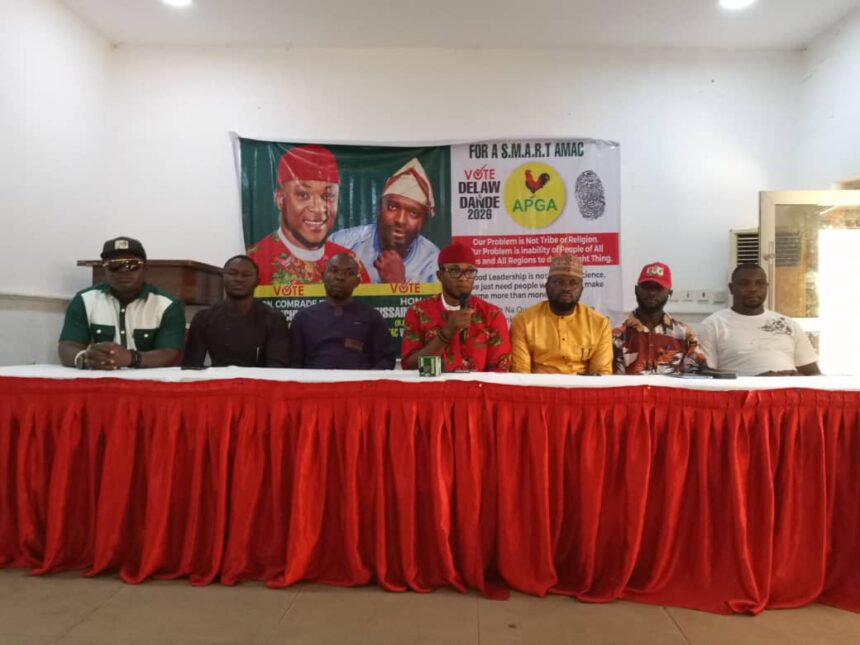
Hon. Comr. Eze Onyebuchi Chukwu (Delaw), the All Progressives Grand Alliance (APGA) candidate vying to become Chairman of Abuja Municipal Area Council (AMAC) in the 2026 election, held a media briefing on Tuesday to unveil his “SMART” agenda, a comprehensive blueprint aimed at rebuilding AMAC through transparency, innovation, and people‑centered governance.
Eze Onyebuchi Chukwu opened his address by explaining that “our problem is not tribe or religion. Our problem is the inability of people from all regions to do the right thing,” underscoring his campaign’s focus on unity and collective responsibility rather than divisive politics. He emphasized that good leadership “is not rocket science; it only requires people who want to make a name not money,” echoing his long‑standing commitment to integrity and service.
The SMART acronym encapsulates five strategic pillars: S– Security of lives, property, and social welfare; M – Modern infrastructure development; A – Accountability and accessible governance; R – Rural inclusiveness, revenue reform, and economic expansion; T – Technology‑driven administration.
- Advertisement -

Under Security (S), Delaw pledged to strengthen collaboration between AMAC, government security agencies, local vigilante groups, and community leaders to create a safe business environment capable of attracting investment.
Modern infrastructure (M) will target equitable distribution of roads, drainage systems, and electrification across city centres and suburbs, ending what he called “selective development.”
Accountability (A) will be enforced through an open‑door policy, public tracking of funds, regular publication of budgets, and strict oversight of contractors to ensure every kobo is accounted for.
Rural inclusiveness (R) aims to block revenue leakages, reduce over‑taxation, and empower small‑scale entrepreneurs, with a promise that “no village will be left unattended to.”
Technology (T) will be harnessed via e‑governance platforms, automated revenue systems, and tech‑based community monitoring tools to curb corruption and accelerate service delivery.
The strategic team, comprising members from diverse tribes and expertise in administration, youth development, advocacy, and community mobilization, stood beside him during the briefing, signalling a united front ready to implement the SMART agenda.
The candidate reiterated his commitment to “One AMAC for All,” symbolized by multilingual unity inscriptions in English, Igbo, Yoruba, and Hausa, reflecting an administration that seeks to carry every resident along.
The campaign has become a rallying point for residents seeking fresh, non‑transactional leadership, positioning him as a movement‑builder rather than a mere candidate.
As the 2026 AMAC election approaches, Delaw’s SMART vision stands as a promise to deliver security, modern infrastructure, accountability, rural empowerment, and tech‑enabled governance – a blueprint residents hope will reshape AMAC into a model of inclusive progress.