

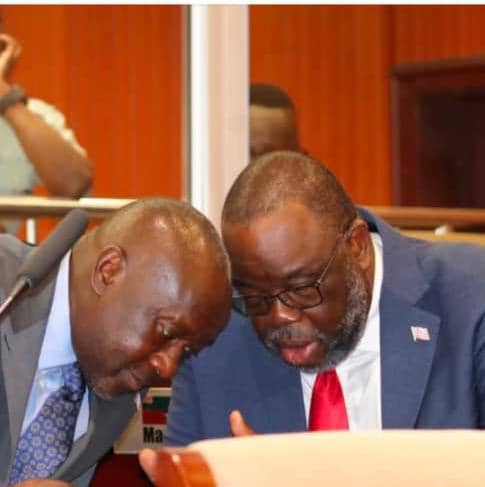
Aleke Aleke in Abuja
Two prominent Liberian senators, Edwin Melvin Snowe Jr. and Amara M. Konneh, have called for an independent investigation into the seizure of 237.6 kilograms of cocaine at Roberts International Airport, citing serious concerns over how suspects linked to the drugs, valued at approximately US$19.2 million, allegedly evaded arrest.
In a joint statement, the senators commended the Liberia Drug Enforcement Agency (LDEA), the Liberia National Police (LNP) and other joint security agencies for intercepting the shipment, but questioned the handling of the investigation and demanded greater accountability.
They noted that although five individuals have been charged in connection with the trafficking case, none was physically arrested before allegedly leaving the country.
The statement said: “According to information released by the authorities, two persons of interest were outside Liberia when the investigation commenced and were subsequently declared suspects.
At the same time, it has been alleged that two of the suspects were present in Liberia during the early stages of the investigation.”
The senators also questioned why the authorities initially declined to identify the “persons of interest”, citing concerns that doing so could compromise the investigation, only to later disclose that some of the suspects had been in the country during that period.
The statement continued: “Simply put, drugs worth approximately US$19.2 million reportedly entered Liberia and were on the verge of being exported through the country’s only international airport. Yet, despite the magnitude of this case, no persons of interest that the authorities knew but could not name and of course no suspect appears to have been physically arrested by national security agencies.”
- NCAA -
According to official statements, the only person currently in custody is a suspect who voluntarily returned to Liberia and surrendered to the authorities upon arrival at Roberts International Airport.
Questioning the country’s commitment to tackling organised crime, the senators asked: “Are we truly serious about enforcing the law and expecting the international community to take Liberia seriously in the fight against organized crime?”
Beyond the arrests, Snowe and Konneh called for a comprehensive investigation into the entire criminal network behind the drug operation, posing a series of critical questions, including: “Who financed the importation of the drugs? How the cocaine entered Liberia—by air, sea, or land? Where it was stored and repackaged before reaching the airport? Who coordinated the logistics of the operation? Which financial institutions may have been used to launder proceeds? Are there additional local and international collaborators? And lastly whether any public officials or state security personnel were involved?”
The lawmakers also questioned how investigators exonerated the individual who transported the drugs, as well as the screener at Roberts International Airport who allowed the suspicious package to pass through security clearance.
The statement emphasised: “Drug trafficking poses a direct threat to our youth, our families, our institutions, and our national security. Given the scale of this seizure and its apparent international dimensions, this matter demands a comprehensive, impartial, and evidence-based investigation that follows every lead, regardless of where it may lead.”
The senators therefore called for “an independent investigation to be conducted with the full cooperation and technical support of Liberia’s international partners to ensure that everyone involved—from financiers and importers to traffickers, facilitators and any public officials who may have aided the criminal enterprise—is identified, investigated and prosecuted.
“The Liberian people deserve nothing less than the full truth, complete accountability, and justice,” the statement concluded.