




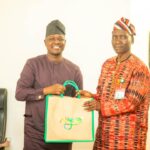



The Federal Government has flagged off the nationwide distribution of 15 million learners’ support kits to vulnerable pupils in schools across the country.
This reaffirmed government commitment to ending the menace of out-of-school children and ensuring that no Nigerian child is left behind.
The flag-off ceremony, held in Makurdi, Benue State, on Friday, coincided with the 2026 Benue State Universal Basic Education Board (SUBEB) Basic Education Summit and the National Launch of the Learners Support Programme (LSP).
- Advertisement -

Speaking at the event, the Executive Secretary, Universal Basic Education Commission (UBEC), Dr Aisha Garba, said the initiative reflects the resolve of the administration of President Bola Tinubu to tackle barriers preventing millions of children from accessing basic education.
Garba said the Learners Support Programme would commence with the distribution of 1,155,900 school kits nationwide, comprising 288,975 units each of school bags, sandals, pencils and exercise books.
This, she said, will be targeted at children from low-income and vulnerable households.
She explained that the nationwide rollout forms part of a broader intervention that will see 15 million school kits distributed across states to ease the financial burden on parents, boost enrolment, enhance retention and improve transition rates in basic schools.
According to her, the Renewed Hope Agenda of the Federal Government is driving a fundamental restructuring of UBEC to build a more resilient and inclusive basic education system.
“This is not just a policy update; it is a solemn promise that no child, regardless of geography or background, will be left behind,” she said.
Garba commended Benue State Governor, Rev. Hyacinth Alia, for prioritising basic education and hosting the national flag-off, describing the state as strategic in advancing reforms aimed at improving enrolment and retention.
She also lauded the leadership of Benue SUBEB under its Chairman, Dr Grace Adagba, for convening the summit themed: “Innovative Strategies for Addressing the Menace of Out-of-School Children: Enhancing Enrolment and Retention of Children in Basic Schools.”
The UBEC boss noted that millions of Nigerian children are still denied their fundamental right to education as guaranteed under the Universal Basic Education Act of 2004, stressing that bold innovation, urgent action and genuine collaboration are required to reverse the trend.
She outlined key strategies to combat the crisis, including stronger community mobilisation, deployment of technology to track and increase enrolment, improved security in vulnerable schools, targeted incentives for girl-child education, inclusive teacher training and expansion of non-formal education options for older out-of-school children.
Garba highlighted ongoing collaboration between UBEC and Benue SUBEB, revealing that the state is up to date in accessing matching grants following reforms that relaxed conditions and improved utilisation.
The move she said has boosted access to funds by over 80 per cent nationwide.
She listed several interventions executed in the state, including the construction of 39 new classrooms, 50 toilets, 15 offices, five libraries, five ICT laboratories and five Early Childhood Care Development Education (ECCDE) centres, as well as the renovation of 182 classrooms and other facilities.
In addition, she said furniture had been provided for 6,668 pupils, 309 teachers and 767 library users, alongside the installation of 13 boreholes and overhead tanks, and perimeter fencing in nine schools.
Garba further disclosed that under the School-Based Management Committee, (SBMC)-School Improvement Programme, 13,670 community-based projects have been delivered in Benue, supported by over N1.5 billion in first-tranche funding to 1,142 schools, impacting more than 430,000 learners.
She reaffirmed UBEC’s readiness to support Benue State in scaling up enrolment drives and strengthening out-of-school children reduction strategies through programmes such as the Learners Retention Support Programme and the Learners Support Programme.
“Today’s flag-off demonstrates that the trend can be reversed. Together, we can ensure that every child in Benue and across Nigeria can learn, grow and contribute meaningfully to the nation’s future,” she said.
The summit is expected to generate policy recommendations and implementation strategies to expand access to quality basic education and address persistent gaps, particularly the challenge of out-of-school children.