






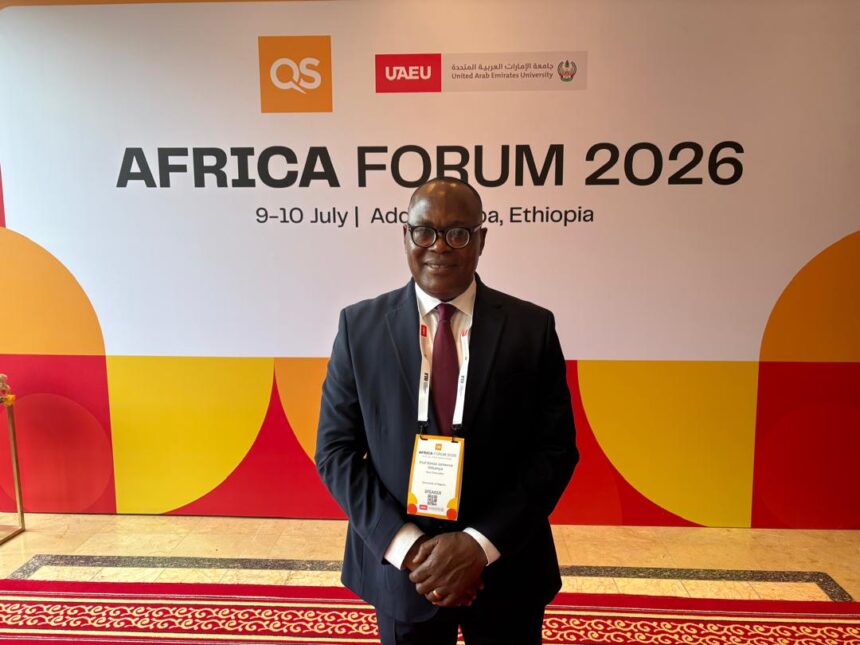
The Vice-Chancellor of the University of Nigeria, Nsukka (UNN), Prof. Simon Uchenna Ortuanya, has projected the University’s vision for sustainable higher education on the continental stage, joining more than 40 university leaders in Addis Ababa, Ethiopia, to chart a future where institutional growth is driven by environmental stewardship and social responsibility.
Prof. Ortuanya was among heads of higher education institutions from Africa, Europe and Asia who participated in the QS Africa Forum 2026, held at Addis, Addis Ababa, Ethiopia from July 9 to 10, 2026.
The Forum, organised by QS Quacquarelli Symonds in collaboration with the United Arab Emirates University, centred on the theme, “Skills, Systems and Sustainable Futures,” which explored how African universities can respond to rising enrolment while maintaining quality, relevance and long-term societal impact.
A major highlight of the Forum was Prof. Ortuanya’s participation as a panelist in a high-level discussion on “Sustainable Higher Education: Aligning Growth with Climate and Social Impact.”
The session examined how universities can expand responsibly by integrating environmental sustainability and social inclusion into their development agenda.
Speaking during the panel discussion, Prof. Ortuanya highlighted the need for universities to mainstream sustainability across every aspect of their operations. He advocated the incorporation of sustainable practices into campus management, infrastructure development, teaching, research and community engagement, stressing that higher education institutions should lead by example in addressing global environmental challenges.
The Vice-Chancellor further identified practical pathways for achieving sustainable development within universities, including embedding sustainability into academic curricula, promoting research that generates innovative climate solutions, and strengthening strategic partnerships that address local and global development priorities.
- NCAA -

He maintained that universities have a critical responsibility to produce graduates equipped with the knowledge, skills and values required to tackle emerging global challenges while contributing meaningfully to national development and sustainable economic growth.
Beyond the panel session, Prof. Ortuanya leveraged the forum to advance the internationalisation agenda of the University of Nigeria. On the sidelines of the event, he held strategic discussions with leaders of participating universities on opportunities for academic collaboration, joint research, staff and student exchanges, innovation, and capacity building.
The engagements are consistent with the University of Nigeria’s strategic drive to expand its global presence through international partnerships that enhance teaching, research, innovation and community service.