






By Chidi Ugwu
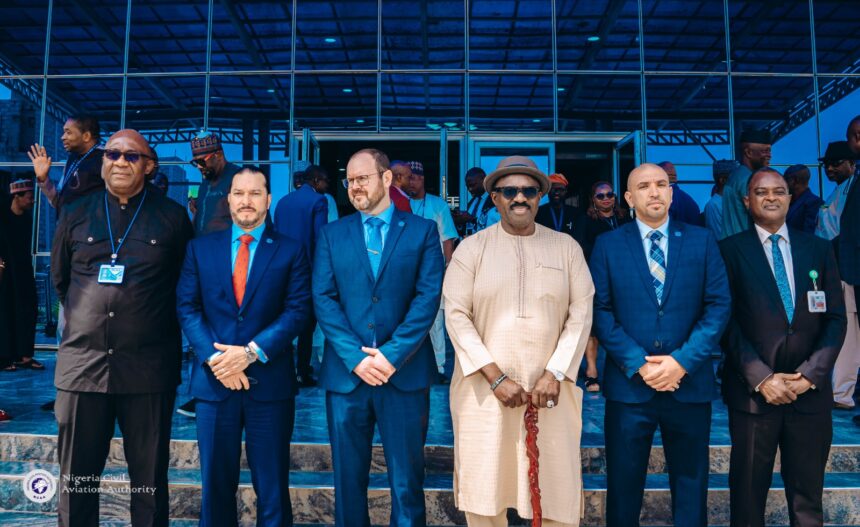
The International Civil Aviation Organisation (ICAO) Coordinated Validation Mission (ICVM) team has commenced the validation of Nigeria’s state’s compliance with aviation safety standards and confirm the effectiveness of corrective actions (CAPs) taken to fix previously identified deficiencies.

Hosted by the Nigeria Civil Aviation Authority (NCAA) on behalf Nigeria, the team will also access the Critical Elements (ECs) of a safety Oversight system.
Welcoming the delegation at a short ceremony signaling the commencement of the exercise, the Director-General, Civil Aviation, Nigeria Capt. Chris Ona Najomo said the Mission is a follow-up to the ICAO USOAP-CMA audit, conducted from August to September 2023, in which Nigeria recorded an Effective Implementation (EI) score of 70.12%.
He said Nigeria has remained resolute and steadfast in her commitment to improving safety oversight capabilities.
“We took the audit findings in good faith and with the utmost seriousness that they deserved by conducting root cause analysis and promptly developing comprehensive Corrective Action Plans (CAPs) to address identified deficiencies. I am pleased to note that these CAPs were subsequently validated by ICAO, providing us with a clear roadmap for implementation” the DGCA noted.
Capt. Najomo highlighted the implemented corrective actions, alongside NCAA’s traditional safety oversight responsibilities. They include:

Actualizing the deployment of EMPIC as the regulatory software for the Authority, specifically in the automation of personnel licensing and aeromedical processes;
Entered into an agreement with NorthWest Data Solution for the deployment of the SMS Pro software as the digital software to entrench the centralization and digitalization of NCAA’s safety data reporting and management system, ensuring compliance with the ICAO Annex 19 requirements on a Safety Data Collection and Processing System (SDCPS); and,
- NCAA -
In fulfilling NCAA’s responsibility under ICAO Critical Element 4 on qualified technical personnel, more than one hundred flight operations and airworthiness inspectors underwent training on special authorization procedures at an EASA-approved training institution in Comiso, Italy and another training organization in Dubai, UAE.
In furtherance to the abive Capt. Najomo said some inspectors are currently undergoing On-the-Job Training (OJT), coordinated under an MoU with the Rwandan Civil Aviation Authority to qualify these inspectors on specialized authorisations. This is in addition to the regular annual training plans that are developed and implemented specially for NCAA’s aviation safety inspectors.
He also stated that Nigeria has signed Memorandum of Understanding (MOU) with the surrounding Flight Information Regions (FIRs) for ensuring safe, orderly and efficient air traffic flow across boundaries.
The NCAAhe said has also implemented a robust rule-making process that ensures complete and on-time transposition of the ICAO Standards and Recommended Practices (SARPs) into the national regulations and subjected Nigeria’s international aerodromes to a 5-phase certification process to ensure all were certified in accordance with ICAO Annex 14, Nig. CARs Part 12 and our documented procedures.
The NCAA also established the first-of-its-kind flight data center situated right in this building to give teeth to the goal of risk-based oversight as part of a robust State Safety Programme (SSP).
According to the DGCA, Nigeria collaborated with the ICAO West and Central Africa (WACAF) Regional office and hosted two ROST Assistance Missions (in September, 2025 and February, 2026) to evaluate its progress. The recommendations arising from those missions have been rigorously implemented across the industry he said adding that all these actions serve as precursors to what has brought the ICAO Coordinated Validation Mission (ICVM).
The NCAA “undertook a broad review of our processes and procedures to ensure they are in tune with current realities, and that they are achieving their intended purposes” he further indicated.
Capt. Nojomo emphasize that “Nigeria is not subjecting herself to these audits and validation missions merely for the sake of improving the numerical E.I score, certainly not! Rather, our overarching objective is to institutionalise a resilient safety oversight system that fosters continuous improvement in safety performance. This aligns perfectly with the Federal Government of Nigeria’s policy on strict adherence to international safety regulations which, in itself, will automatically elevate Nigeria’s ICAO rating.”
The ICVM Team Lead, Mr. Jerome Patoreaux in his brief remarks spoke to the eight critical elements of a safety oversight system:
They include: CE-1 Primary Aviation Legislation: Adoption of relevant legislation to enable compliance with Chicago Convention standards. CE-2 Specific Operating Regulations: Regulations for regulating civil aviation, such as safety oversight. CE-3 State System and Functions: Establishment of a safety authority with proper structure and resources.
Others include: CE-4 Qualified Technical Personnel: Recruitment and training of qualified staff for oversight. CE-5 Technical Guidance, Tools, and Procedures: Providing necessary tools for technical personnel to perform oversight, as detailed in the ICAO Safety Oversight Manual. CE-6 Licensing, Certification, Authorization, and Approval Obligations: Documented procedures to ensure compliance before authorizing activities. CE-7 Surveillance Obligations: Implementation of audits and inspections to ensure continued compliance.
CE-8 Resolution of Safety Concerns: This include measures to resolve identified safety issues. ICAO uses these elements to evaluate a State’s capability through its USOAP Continuous Monitoring Approach (CMA).